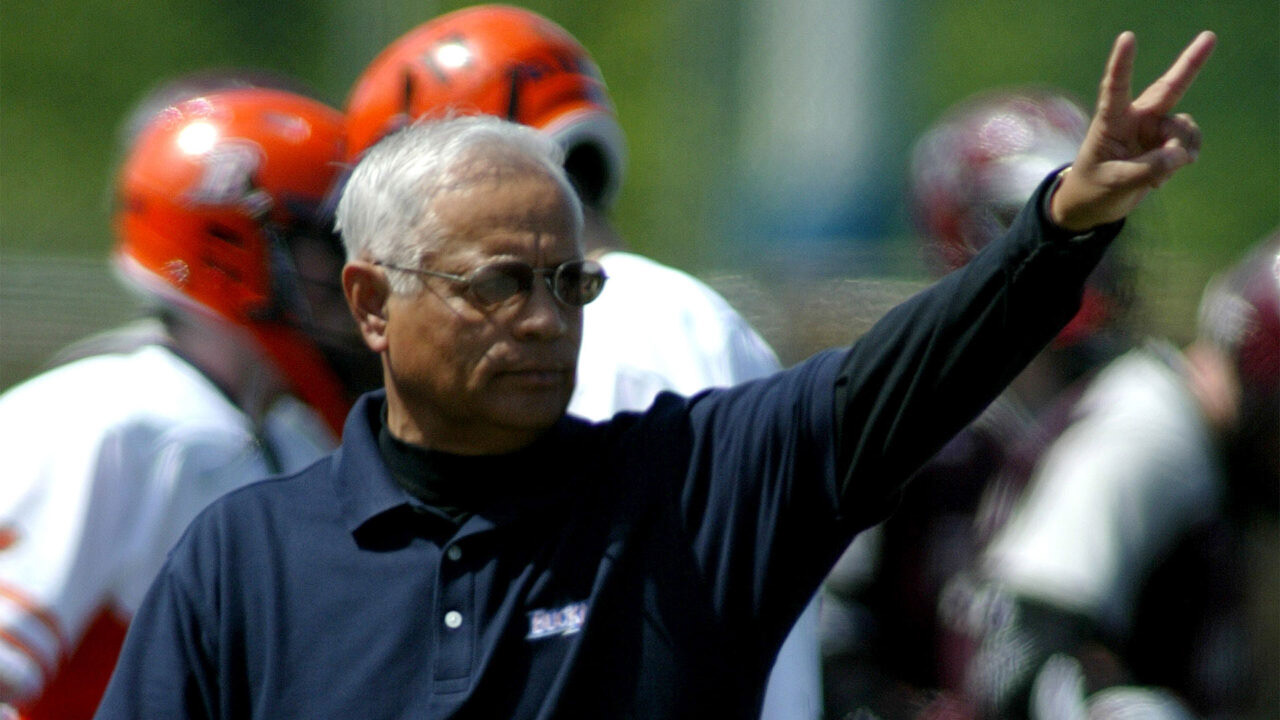
Coach Sid Jamieson, Bucknell Lacrosse
What All Coaches and Players Should Know
Sid Jamieson coached lacrosse at Bucknell University for 38 years and continues to spend time on campus with the coaches and players. For the first 25, he also coached Bucknell's football team (because that was the job he was actually hired to do). He had to prove Lacrosse mattered.
And that he did, by building a Division I program from scratch in 1965 and coaching it through '96, racking up over 240 wins, seven conference titles in three different leagues, and mentoring 17 All-American players. Sid has won, and continues to win, awards and accolades around his work as both a coach and an environmental leader.
Jamieson is Cayuga, his parents born on the Six Nations territory in Ontario. He co-founded the Iroquois Nationals in 1983 and ran it for years afterward, taking the team to England, Australia, and Japan. He remains the only Native American head coach in Division I history.
But when you ask him about lacrosse, he doesn’t start with any of that. He starts instead with his respect for the stickmaker; walking the woods, selecting the perfect tree, thanking the tree before he cuts it, and telling the tree how important his gift is. For the medicine game.
And that's the part of the game many coaches and players don't know. Here's what he wants them to know.
The game was never just a game
Before youth teams spread across the nation, college teams at all levels, professional men’s and women’s leagues, and international tournaments, lacrosse was a ceremony. It was an offering. It was community. It was sacred. For Sid, it, of course, still is.
Jamieson crafted a beautiful written statement about the meaning and power of lacrosse that he reads prior to his many lectures, interviews and engagements. Here's the whole story, in his words:
"The history and culture of the Creator's game of lacrosse is older than any date recorded. We know that Native Americans played the Creator's game for spiritual and physical ceremonial reasons. And, we know that field lacrosse is the first "team" game in North America. The actual game itself at times was ferocious as the winner often took the bounty.
Players were/are selected/approved by their clans and poor effort or cheating is not accepted. And, in some cases, you could be banned from ever playing again.
We would find participants at a peak of physical preparedness and with a good [spiritual] mind playing for the amusement of the Creator. The participants hoped that the Creator would look favorably upon their effort during the game as a demonstration of their personal character. The toughness of play held no bad feelings as both teams realized the sincerity of the effort. Without the disciplines of dignity and honor, violence may result, and bring disgrace to your Nation, your people, and your teachers. Vanity, brutality, and anger are not part of the Creator's game. The outcome of a game is what it is and respect for the winning team/players is mandated in the Creator's will. Today, the post-game handshake of all players and coaches is that demonstration of respect and honor for each other and the game.
Lacrosse is played best when it reflects creativity and innovation. The game becomes a thing of beauty, individually and as a team, as evidenced by the seemingly endless variety of stick skills, hidden ball tricks, and imaginative shooting.
There are three different lacrosse games: field lacrosse, box lacrosse, and the medicine game. The field game could become more than just a spiritual or physical ceremony... it could be played to settle community differences or in preparation for conflict. It also would become a ceremony honoring all of the last participants and it would continue the traditional way of life.
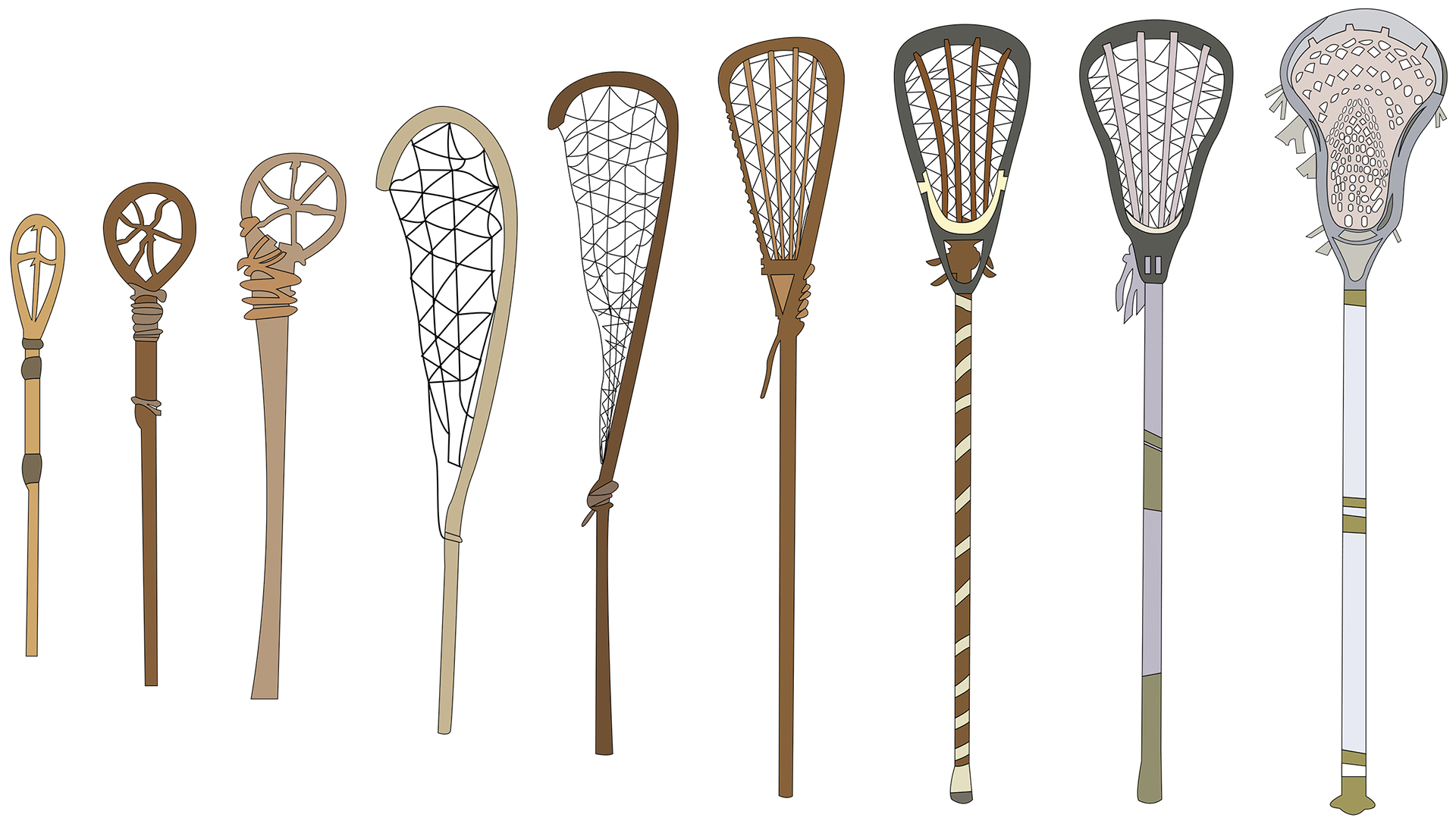
The medicine game is played as an interwoven community demonstration of strength for good medicine in helping heal the sick in a community. Only wooden sticks are allowed and a specially made ball of good medicine is used. The more players, the stronger the medicine becomes.
It is said that when we play the game, there is a parallel game in the sky world... which is why you take your stick with you to the sky world.
The power of the game is sacred and demands purity of mind, spirit, and respect. You learn these three components as a youngster and, if any are missing from your play, you are weakened to the opportunity for failure. In essence, the Creator's game is a code of conduct and strategy for living our lives.
And the stick is a form of medicine helping generate good thoughts, sportsmanship, and strength.
If we respect and honor the past, then, the Creator's game mandates that the game is much more than just a game. It is a demonstration of who we are. We have been presented this opportunity to express our being. The challenge then becomes who are we really? as the game unfolds (throughout our lives)."
Players were selected by their clan, their representation considered an honor. The game itself was sacred, as were the sticks. The more that played, the more powerful the medicine. So vanity, a lack of effort, a cheap shot, anger, or unfair play weren’t simply fouls. They were transgressions; unrespectful and disgraceful. And they could get you banned from the game!
Jamieson tells the story of a young man at the smoke shop of his own territory who disrespected a clan mother's decision, too aggressively. The clan spoke as one. He never played again. Lessons that transcended the game were learned quickly. Don't mess with the clan mothers. That high standard of dignity and honor manifests itself today in the postgame handshake. Jamieson wants to be sure people playing the game know that's where it came from.
Good medicine is a real thing, and it travels
There are three versions of the traditional game, Jamieson explains: one for settling disputes, one for honoring players, and the medicine game to heal a community. The power of the medicine game, he is careful to note, comes from the wooden sticks, made the traditional way.
The stick maker walks into the woods and thanks the tree before cutting it down. He takes his time to glorify his craft, carving and bending the carefully chosen piece of wood into a soon to be usable stick, explaining to the tree its importance. The completed stick was strung by a woman in the community and when she finished, she would never touch that stick again.
"That's where you get your respect," Jamieson says, "when you get the medicine from your wooden stick, you can play with good medicine that day, and the more people who play, the stronger the medicine gets. The more often you use the stick, the stronger the medicine."
Discipline isn't punishment. It's respect for the group.
Ask Jamieson about his best player and he'll tell you about the time he benched him. He sat the kid down two weeks into the season and told him, "You lose the ball, and you don't want to chase it. Somebody scores, and you don't care. You're just not there. It's all about you and nobody else. And as long as that attitude is persistent, you're never gonna play here."
The player left. But he returned the next year and said he really missed playing. Jamieson told him the rules were still the same, they hadn't changed. The player agreed and went on to become the only player Jamieson ever let address the entire team. He had changed. The game changed him.
Another player, after being squarely beaten, took the butt end of his stick to another opponent in frustration, away from the play where the officials couldn't see it. But Jamieson saw the cheap shot from the sideline. "I said to my assistant coach at the time, take him into the locker room, take all of his equipment, he's done, he's never gonna play."
Every player signed a sheet at the start of the year.
1. Don't embarrass yourself.
2. Don't embarrass the team
3. Don't embarrass the University.
If somebody did, Jamieson pulled the sheet back out. "You embarrassed yourself, you embarrassed me, you embarrassed the program. You signed this. I don't have any recourse now, you're done." No lecture needed. They'd already agreed to the terms.
It's the same logic he applies to community, on the Onondaga territory and on his roster alike: "If you take care of your part of it, you're welcome here, and if you don't, you're not welcome here anymore."
The best players aren't always the ones you recruit
The starting goalie for Bucknell's undefeated 1996 season hadn't played the position since ninth grade. He was a midfielder Jamieson wasn't sure would even make the travel roster, until the actual starting goalie got suspended for trouble downtown and Jamieson called an emergency team meeting asking if anybody, anybody, knew how to play keeper.
"There wasn't any kind of a response. I'm thinking, oh man, what the hell are we gonna do now. And then this one kid in the back goes like this (raises his hand), and I said, yeah? He says, well, coach, I played goalie in ninth grade, but I haven't played goalie since."
First game of the season, at Navy, at night. Bucknell lost the opening faceoff, Navy's attackman beat the defender and ripped a shot on goal.
"My goalie sucked it up. Outlet the ball, fast break, we're up one nothing. We wound up winning the game with this kid who hasn't played goalie since ninth grade. He was the 1996 undefeated team's goalie. He deserves to be on the Legends board. That's a true story."
Jamieson tells that story not as a fluke but as a lesson: you don't always get to pick who shows up for you. You get to decide whether you'll use them.
Nobody is telling the story, and that's the real problem
Jamieson spent years pushing US Lacrosse to blend Native history and culture into a module in the coaching certification. There's still an annual session about it at the national convention but it has never become a requirement, “It hasn't happened. I don't know why, or what the reasoning is."
He doesn't think coaches or players are uninterested. He thinks nobody's put it out there, in front of them. When he would guest-lecture in history or anthropology classes at Bucknell University, you could hear a pin drop. When he told his stories to kids who'd grown up an hour from Onondaga territory, they were shocked. They had never heard about the game origins, it's powerful stories and its connections to the spiritual, the creator, and the environment.
Jamieson spent decades doing the outreach himself, on his own time: holding clinics through Johns Hopkins' American Indian Health Services program in New Mexico or working with the Pennsylvania Department of Conservation and Natural Resources, He spent years helping broker what became the Susquehanna River's designation as a National Historic Water Trail, shepherding his Federal partners (who wanted an answer in two weeks instead of two years) through the seven generations decision-making process.
Standing with a Haudenosaunee chief on a platform overlooking the river during that process, a fish breached the water right in front of them. "He turned to me and said, that's the fish telling me this is a good thing." At the signing ceremony in Annapolis, an osprey circled overhead the entire time and didn't leave until the group did. "The birds are telling me this is a good thing to do.”
The game gave him all of it, he says. Not because he went looking for any of it, but because he coached lacrosse, and lacrosse kept opening doors he never could have planned for. “I mean, you can't make these things up."
What this means for the next coach, and the next player
You don't have to be Haudenosaunee to take Jamieson's version of the game seriously. You have to be willing to take seriously the long history, tradition and sacredness of the game. Its roots. Players and coaches alike need to be held to the high standard embraced by those who first played the game: effort without vanity, toughness without cruelty, and respect for the people across the line from you, win or lose.
This respect for people highlights the importance of relationships, which Coach Sid stresses repeatedly. The most important things he says he has gained from lacrosse are the relationships he has made along the way. And those relationships are anchored to this shared history, love and respect for the game.
"I just coached lacrosse. That's all. But all of these great things happened to me. I'm fortunate enough to have had opportunities simply because I am who I am, and lacrosse opened up a lot of roads, different roads for me."
Fly a Haudenosaunee flag. Honor the game. Let kids know the handshake line isn't just tradition, it's the whole point. Respect the clan mothers. Respect the creator.
Jamieson didn't build a Hall of Fame career by recruiting the best talent. He built it by refusing to let the game be smaller than it should be. That's the story he wants passed down, seven generations out and counting. It starts with whoever tells it next
This story stems from close connections to Bucknell, the Susquehanna Valley and lacrosse in Lewisburg, Pennsylvania, the lands of the Susquehannock, Lenape, and the Haudenosaunee (Iroquois) Confederacy. This edited talk was a time for Eric Martin, and his son Wyeth to listen to Sid, and give the space his voice deserves.
Eric & Wyeth Martin, August 2026